The Design of HONDA’s Electric Motorcycle “EV OUTLIER Concept”


TEXT: Osamu Namba
PHOTO: Tatsuo Nagano
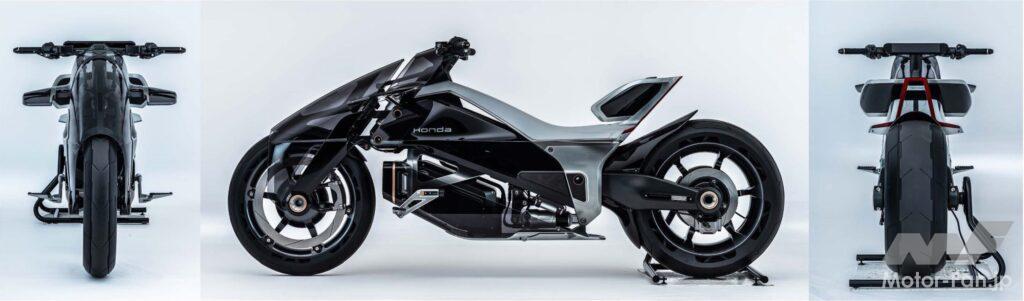
OUTLIER = An Existence Unbound by Convention
We had the opportunity to speak with Taro Nishimoto, Creative Director and Head of the Motorcycle & Power Products Design Division at Honda R&D Design Center, Assistant Chief Engineer Yuya Tsutsumi who served as LPL (Large Project Leader), and Chief Engineer Yuichi Yokoyama about the development of the “EV OUTLIER Concept” — a concept model that aims to deliver an unknown riding experience unlike any existing motorcycle, free from conventional thinking.
This model was conceived as a vehicle looking even further into the future, following in the footsteps of the EV Fun Concept and EV Urban Concept announced at EICMA in 2024. By challenging three themes unique to electric vehicles — “surprise and excitement,” “value only achievable through electrification,” and “new design born from that” — the aim was not simply to replace an internal combustion engine with an electric powertrain, but to explore the possibilities of an “OUTLIER = unbound by convention” existence, treating this as an entirely new category and asking how it can evolve.
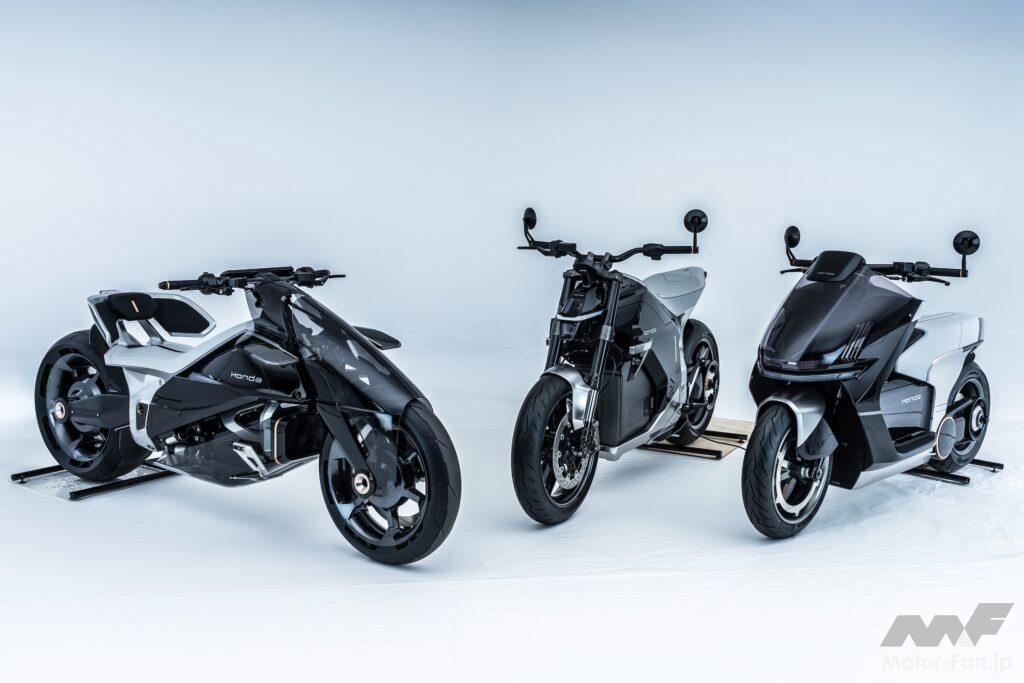
Three models designed under Honda’s shared electric two-wheeler design theme: “Precision of Intrinsic Design.”
Starting with a Reset of Existing Values
In considering the three themes without being constrained by conventional thinking, this project began by resetting existing values. Active trial and error was carried out by a multinational, cross-disciplinary team that included not only designers responsible for domestic two-wheelers, but also designers from the power products domain and design members from overseas bases. In a typical mass-production development process, exterior components are built around a layout determined by engineering. In this project, however, everything — from battery mounting angle to suspension configuration — was reconstructed under design leadership. The sketches that emerged from this process were diverse depending on the designer: some drew extremely radical proposals aiming for “surprise,” while others drew more conservative ones.
The Dynamic & Low-Position Package Born from the Freedom of EV Layout
To create “surprise and excitement,” attention was first directed to the riding position. Based on the idea that “a rider’s physical sensation changes dramatically depending on seat height, and that a difference in riding position is key to an unknown riding experience,” the layout began from the rider’s position — lowering the hip point and pushing the eye point as low as physically possible — in order to produce a refreshing field of view and an overwhelming sense of acceleration not achievable on conventional two-wheelers. Honda aimed for a seat height that stands out as exceptionally low even within its own two-wheeler lineup.
To realize “value only achievable through electrification” by taking advantage of the free layout unique to electric vehicles, the motor — replacing the engine — was decoupled from the main body and adopted an in-wheel motor drive system, achieving an overwhelmingly low riding position. With a gasoline-powered vehicle, the package is difficult to change significantly; this is a package that was only made possible because it is an EV.
By pushing the seat height to an extreme low that would be impossible in a conventional gasoline vehicle, the rider’s eye point also drops, changing the visible field of view, the perceived speed, and the riding feel. This is intentional — to deliver an experience completely different from any gasoline vehicle to date. In terms of performance as well, by enabling two-wheel drive via front and rear in-wheel motors with electronic control, riders can experience an unprecedentedly smooth driving force and overwhelming acceleration. This is what creates “surprise and excitement.”


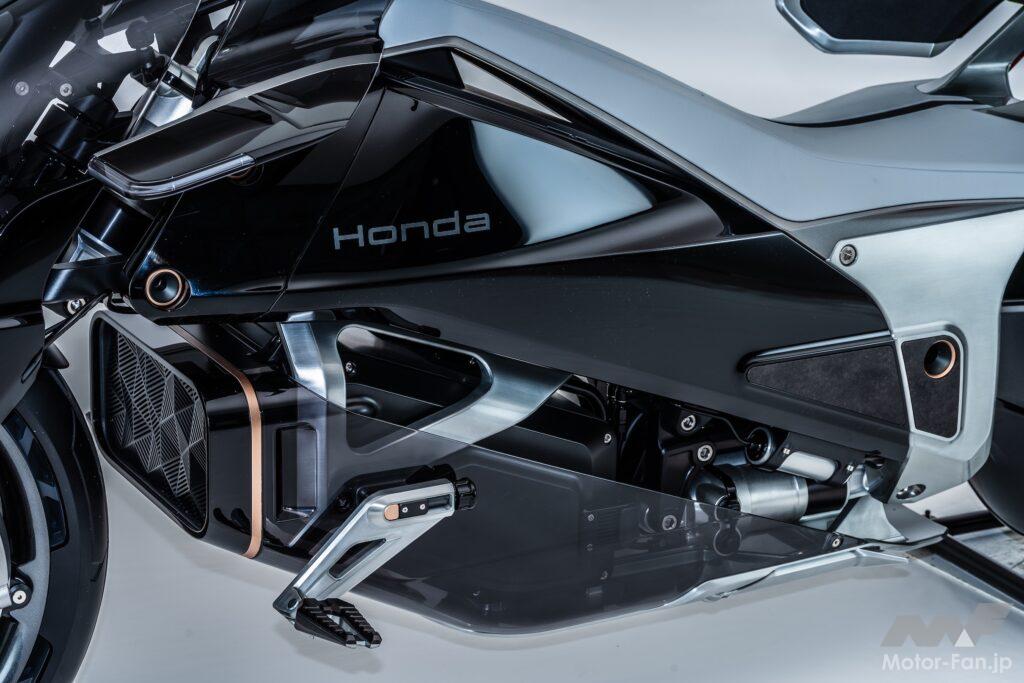
“New Design Born from That”
New design born from a dramatic change in proportions away from the existing motorcycle package
By adopting front and rear in-wheel motors rather than mounting the motor in the body, the motor was first decoupled from the chassis. The battery — a heavy component — is positioned along the roll axis to ensure dynamic performance. The design that emerges from this package is clearly unlike anything before. Yet the result is something that doesn’t stray too far from a motorcycle, while still conveying a sense of the future.
Although it is a styling that communicates change at a glance, the goal was to create something that could still surprise people while unmistakably remaining a “motorcycle.”
In two-wheeler design, where functional components and the skeleton are exposed, the layout of the package and functional parts directly connects to the appeal of the styling. As a result, fine-tuning their appearance and achieving a comprehensive design becomes essential. The work of starting from the skeleton, then having the project leader (designer) come in to examine the package, is perhaps carried out even more closely than in four-wheeler design.
Also, for example, while advancing the clay modeling process, situations arise where a layout that satisfies both design and function cannot be achieved, requiring major changes to the main frame. With a four-wheeler in mass-production development, it is not possible to go back that far, but with a two-wheeler, if something doesn’t work, it is not uncommon to make sweeping changes from the fundamental design.
On the Design Development Floor
While designers draw sketches, 3D data production progresses simultaneously, so the overall volume is largely grasped at that stage. However, in pursuing this special riding position, a package model was produced, and verification of the eye point and field of view was also carried out — including removing the seat from one’s own motorcycle and actually riding it to confirm. Additionally, while the modeling work was driven primarily by 3D data, the overall vehicle size and wheel size were revised numerous times before arriving at the final form.
Proportions
If the entire vehicle is simply lowered, the low seat height no longer stands out. Therefore, volume was deliberately given to the front section, creating proportions that make the rider’s low seating position all the more prominent.


Seat
Aiming for an exhilarating riding feel unique to an electric motorcycle — where rider and machine feel as one — the bucket-type seat’s backrest firmly holds the body, absorbing the overwhelming acceleration of motor drive while also providing a new sense of control as the rider sweeps through corners pivoting at the waist. This enables a riding feel of surprise and excitement unlike any existing two-wheeler.
The seat shape, which flares out to the left and right to envelop the rider, also serves a protective function — guarding the user from side impacts by automobiles, a consideration that arises from the low seating position.


HMI
The meter adopts a thin, wide layout to ensure a broad field of view for the rider, and the mirrors are camera-based. The interface also allows the rider to intuitively grasp the vehicle’s lean angle and behavior. The left and right sides of the meter function as rearview mirror monitors, with cameras mounted near the left and right of the taillight. The HMI design also aims to create a riding experience where new awareness and discovery arise every time the rider mounts up — including a sub-display that shows real-time changes in motor drive status and output characteristics according to riding mode, control tailored to the user’s riding skill level, and route suggestions based on the user’s schedule and preferences.


The Possibilities Demonstrated by the EV OUTLIER Concept
While pursuing the possibilities of an “OUTLIER = unbound by convention” existence through the three themes, the team wrestled with the balance between wanting to reach new customers and, at the same time, wanting to resonate with riders who love existing motorcycles.
This was because, while an electric vehicle would likely be more approachable and lower the barrier compared to a gasoline motorcycle for those who had found conventional bikes daunting, there was concern that criticism might come from those who love and are devoted to gasoline-powered bikes.
However, the response turned out to be far more positive than the development team had anticipated. Many gasoline vehicle users responded favorably, saying things like, “If it’s this new, I’d want to try it.” The fact that an EV with such a bold transformation of values from existing models was accepted by users became a major insight for the future development of electric two-wheelers.


カーデザインの関連記事


「100年を超えて輝き続ける宝石たち」世界最高峰のビスポークモデルを作り続ける「ロールス・ロイス」

1970年代キャメルGTチャレンジ参戦車両を現代に甦らせたワンオフ仕様「ポルシェ911S/T」登場

グラン・カナリア最高標高の村に着想を得た「ベントレーベンテイガ アルテナーラエディション」

![by Car Styling [カースタイリング]](https://motor-fan.jp/wp-content/uploads/2025/04/carstyling-jp_logo.png)
中国モデルメーカーの現状を見る。熾烈な競争を続ける中国自動車産業、その要を担うモデルメーカー_Part 2/上海SKY

中国モデルメーカーの現状を見る。熾烈な競争を続ける中国自動車産業、その要を担うモデルメーカー_Part 1_MOTIVO
