Perceived quality and Cohesiveness [Perceived Quality Series Vol. 5]
![by Car Styling [カースタイリング]](https://motor-fan.jp/wp-content/uploads/2025/04/carstyling-jp_logo.png)

In Vol. 4, we discussed how a car’s sensory quality might be rooted in the region’s automotive and human history, its culture, and the local materials and aesthetic consciousness that elevate these elements to their highest value.
In this issue, I would like to explore the idea of sensory quality and cohesion from the perspective of what constitutes truly consistent design.
TEXT: Seri Mizuki
PHOTO: Seri Mtzuki
What does “Perceived quality” refer to?
In previous articles, we have discussed concrete methods of perceived quality and its practical applications in the field.
This time, I would like to take a step back and reconsider the background of why perceived quality is so highly valued, and what exactly perceived quality refers to in the first place.
Now then, the word “Centered” has become quite popular in recent years, especially among sauna enthusiasts. However, it isn’t limited to saunas — it’s often used more broadly to describe the act of resetting one’s mind in a positive way, bringing order to what is chaotic, and restoring balance.
Although some may consider it just a trendy buzzword, in reality, isn’t this very sense of “Centered” something we fundamentally need and seek in order to live our lives?
For example, when our living space or surroundings are cluttered or untidy (though the degree of tolerance may vary from person to person), it doesn’t feel very comfortable, and we somehow feel unsettled.
In a way, I think this reaction is an instinctive feeling for us. Being in a harmonious and organized environment brings a sense of security and creates inner peace.
I believe that a well-ordered space has the power to satisfy such fundamental human desires.
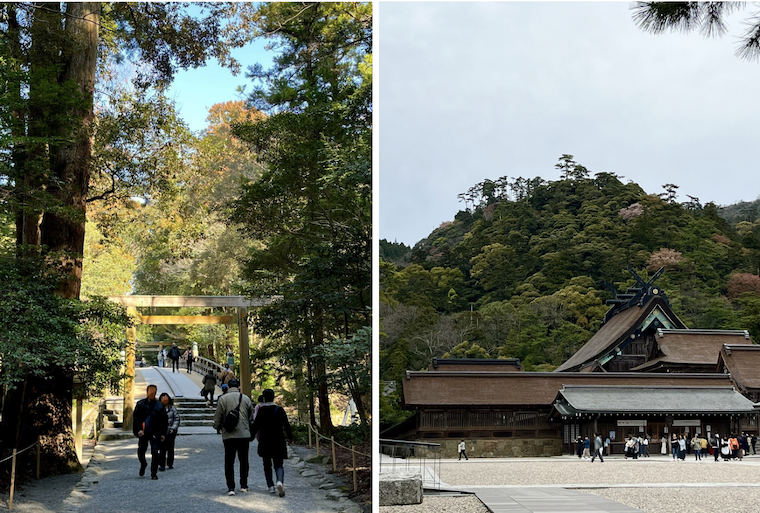
Both are set within nature, yet their entire precincts are meticulously ordered, embodying a form of “Centered ” (harmonious alignment and purification) that calms and centers the mind.
Cohesion
As a core concept of perceived quality, cohesion is valued most highly.
This idea, which can also be interpreted as harmony, is positioned at the very top of the evaluation criteria. While many car design themes vary in expression depending on the model and target audience — and the amount of design elements (including decorative panels and other embellishments) also stems from each car’s concept — what is ultimately crucial is whether all these elements are expressed with a high degree of unity within the styling. It is no exaggeration to say that this cohesion determines the overall level of design perfection.
When we think, “What exactly does cohesion look like?” the first things that come to mind might be whether the impressions of the front and rear of the exterior match, or whether the exterior and interior convey a similar feel. But why do we feel this way?
It is likely because, at its core, the design rhymes — the elements are arranged in a fractal-like manner throughout. For example, aligning the motifs of the grille and the lighting elements, or matching the theme of the vent grille knobs with the inner door handles.
※Fractal (theoretical) : This indicates that parts of a form and the whole form resemble each other or have the same shape, that is, they exhibit self-similarity.
This approach makes it easier for viewers to interpret the design and conveys a sense of fun, so I think it’s a good method overall. However, in some cases, the repetition throughout may create a somewhat tedious or overbearing impression.
What is a consistent design?
Then what is the difference between a simply harmonious design and a consistent design? One way to think about it might be the “depth” — how deeply the theme is explored and how profoundly the design intention is embedded. How do the shapes and motifs relate to the identity that the car is trying to express? How does it embody the brand story as a unified whole?
When a person encounters such a design, there is first a fundamental, instinctive desire to “feel organized” that is visually satisfied. Almost simultaneously, the concept that the design wants to convey rapidly permeates their senses, and if that concept resonates with them, it deeply moves their heart. I believe this flow represents the essence of “emotional quality” (although this is still just a hypothesis).
In the real world, designers constantly think through themes that will resonate with their target users, generating ideas every day. But perhaps this only truly works when placed on a “framework of order” — a foundation that allows these ideas to shine.
If not only designers but all development members recognize and share this framework, then naturally, more appealing and powerful expressions will emerge. This may sound idealistic, but I can’t help but believe it to be true.



