For Aspiring Car Designers “The Journey of a Car Designer – Part 6 (Hyundai / First Half)” [Shikado’s Column #10]



2001: A Turning Point
Since joining Chrysler Corp. in May 1994, I had been involved in the development of numerous concept cars and production vehicles. At the 2001 NAIAS, I unveiled the production Viper, and shortly after, development began on a race-dedicated vehicle based on the concept car Viper SRT-10. My heart was turning toward the racetrack, and I felt we had welcomed the 21st century in spectacular fashion — but then, on September 11th of that year, the catastrophic 9/11 terrorist attacks occurred. The gentle tailwind suddenly shifted direction, and a strong, prolonged headwind swept across all of American society.
In the immediate aftermath, we in Michigan were somewhat removed from the scene and did not feel a major direct impact. However, the effect this event had on the entire United States was immeasurable. Consumer spending tightened first, and the things people stopped buying were, in order, the most expensive — real estate, and then automobiles. Car sales in the United States dropped sharply following the attacks, casting a long shadow over the finances of automakers. Over the two years of 2002 and 2003, various changes occurred within the company. The one closest to me was the cancellation of the race vehicle development project based on the concept car Viper GTS-R.
From 2002, the company’s financial condition gradually began to deteriorate — something that was all the more visible to those of us on the inside. By 2003, even within the design studio, rumors flew that senior designers and directors were being encouraged to take early retirement, and that layoffs were being handed down to younger staff as well. I myself was faced with the need to think seriously about my own future.
Every Cloud Has a Silver Lining
True to the saying “when one door closes, another opens,” an opportunity came rolling my way. Even amid the post-9/11 recession, the NAIAS continued to be held, and with it, the Designers’ Night. At this annual occasion — a chance to reunite with old colleagues in the design world — a former classmate of mine from ArtCenter (ACCD) about 20 years prior, Dragan Vukadinovic, who was at the time a designer at Hyundai USA, told me that Hyundai was planning to place greater emphasis on the US market and was building a large, independent studio in California.
Of course, I wasn’t limited to just one option; I reached out to several companies. But the Hyundai opportunity sounded compelling, so I decided to take on the challenge, and in the summer of 2004, I headed to the newly established studio in California. The Chief Designer who interviewed me turned out to be Joel Piaskowski, the son of Gerry Piaskowski — one of my former supervisors during my Chrysler Design days. Since I already knew Joel personally, the interview was conducted in a very relaxed atmosphere, and I received an offer the same day. I decided then and there that this was where I wanted to do my design work.

Development of the Hyundai GENESIS Coupe
My work at Hyundai USA began in September 2004. After completing several facelift projects, the more substantial work got underway. Hyundai Design North America (HDNA) was at the time a small organization of around 25 designers (including management) — a scale reminiscent of the Italian carrozzerie I had once admired. And its greatest strength was its talented group of young designers in their 20s and 30s.
My first major project at HDNA was not so much a model change for the Tiburon, but rather the design of an all-new vehicle — the Genesis Coupe — a small, two-door, rear-wheel-drive coupe, which was quite rare for the era. The designer who shone on this project was Eric Stoddard, who had designed several concept cars during his time at Chrysler and had also competed with me on the Viper project. He demonstrated his unique creative vision to the fullest, designing a distinctive and sporty coupe.


The next project I tackled was the second-generation Tucson SUV and the sixth-generation Sonata 4-door sedan, both planned for a 2010 production launch. The Tucson project involved little change in size or packaging from the previous model — it was, in essence, a skin change. Eric again proposed an excellent design, and in the full-size phase, he collaborated with the headquarters design team to achieve outstanding results.


The Hyundai SONATA Project
Running on nearly the same schedule, overlapping with that project, was the Sonata project. The studio had two US-hired engineers, and for each project, two or three engineers would come from headquarters in Korea on assignment to support us. At the time, Hyundai’s president had issued a directive that engineers should do their utmost to fulfill the designers’ requests, which made our work as designers considerably easier to carry out.
For example, on the Sonata project, while rough dimensions had been determined, I proposed — drawing on my past experience — reducing the overall height by 20mm in order to give the 4-door sedan a more stylish appearance. Simply lowering the roof would compromise interior room, so I proposed lowering the floor itself by 20mm. From experience I knew this was far from a simple task, but the engineers who had come from headquarters stayed in close contact with various departments back in Korea, and ultimately made the minus-20mm a reality. I will never forget that their support was behind the success of the sixth-generation Sonata.

The designer who led the Sonata project to success on the design front was Andre Hudson. In fact, Eric was also involved in this project.

At the time, Eric had also proposed good ideas for the Tucson, which was running on nearly the same 2010 launch schedule. He was sent on assignment to Korea for the Tucson, which meant he could no longer continue development on the Sonata. Andre took over that Sonata project and carried out the full-size development at the US studio.


He brilliantly translated the design concept I had set out from the beginning — a sleek and flowing style theme that would shatter the conservative sedan image Hyundai had carried until then — into physical form.

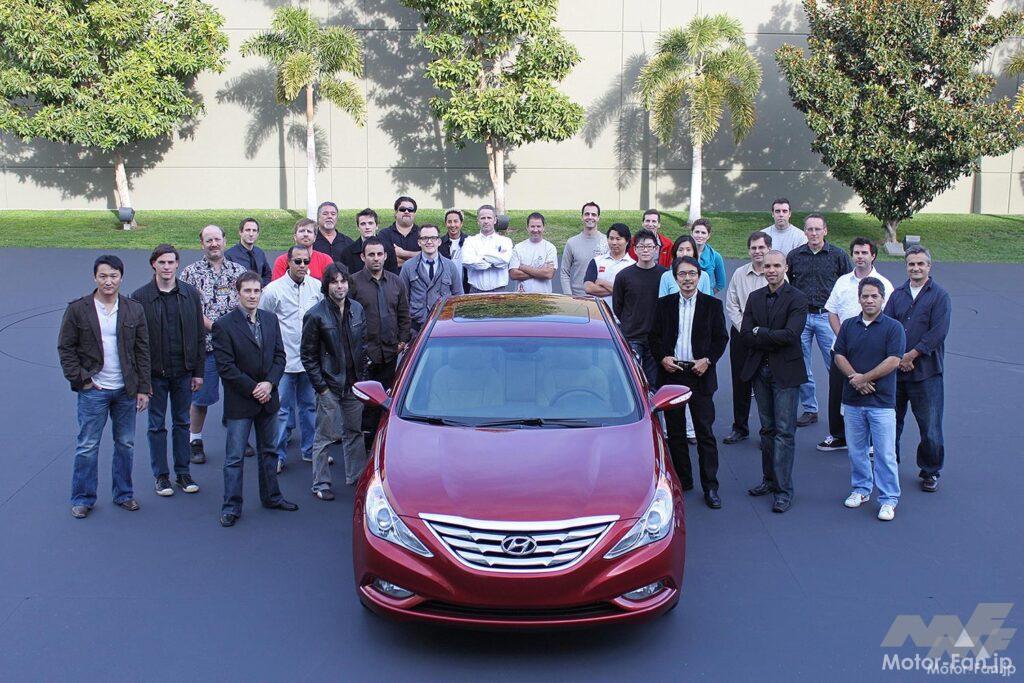

At that time, Hyundai had three design studio locations: the headquarters in Korea, the US studio, and the European studio, with varying combinations participating depending on the project. The typical workflow proceeded as follows: the US studio would develop sketches and scale models → all participating studios’ models would be gathered at the Korea headquarters for a joint review → two or three themes would be selected → the responsible studio would develop a full-size model → five or six months later, the completed full-size model would be airfreighted to Korea, painted and fitted out by local suppliers, and then presented at headquarters for final approval. Airfreighting a full-size clay model weighing several tons may seem unimaginable today.
Hyundai ELANTRA Development Begins
Shortly after the full model change project for the Sonata concluded, the full model change project for the compact sedan Elantra got underway. The most important lesson I took away from my time at Chrysler Design is that the impression a car makes is determined more than 80% by its proportions. So I always gathered information on competing vehicles and compared photos alongside dimensional data. Around this time, the 2006 Honda Civic Sedan was introduced as a car in this class. Its proportions were more innovative than any other compact sedan of the era, so I immediately investigated its dimensions, used them as a benchmark, and began building the packaging for the next-generation Elantra. Here too, Hyundai’s engineers were cooperative and helped create an outstanding package. And from there, it was our turn as designers.
Once again, Sedrick De Andre, one of the design staff at HDNA, did remarkable work. The design language that would come to define the wave of Hyundai vehicles released one after another in the 2020s — known as “Fluidic Sculpture” — I believe owes its establishment as a signature identity to this very Elantra sedan.

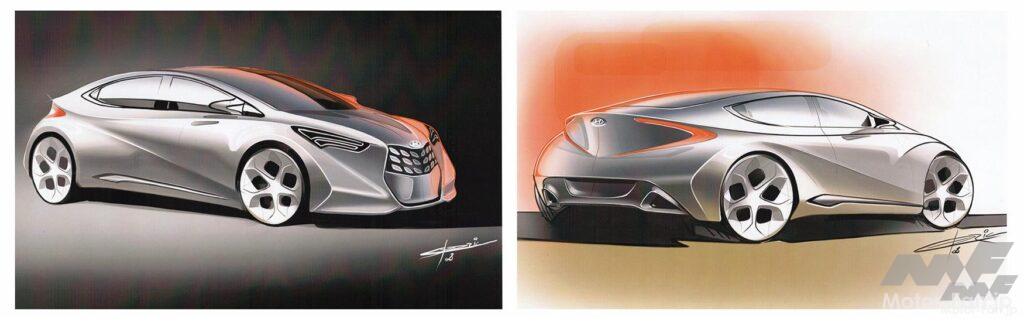
After this, the design output of HDNA accelerated even further, with development beginning not only for the Hyundai brand but also for the new luxury brand Genesis. That story will be for next time.
カーデザインの関連記事

![by Car Styling [カースタイリング]](https://motor-fan.jp/wp-content/uploads/2025/04/carstyling-jp_logo.png)
世界初、曲面で光るデジタルOLEDを採用。TT RSから10年、アウディQ9のテールライトが到達した新段階


スバルはなぜ「この顔」を捨てたのか? 2003年のB11Sが描いた未来と、ヘキサゴングリル誕生の真相

全長3mで4人乗りを実現。フィアット・ムルティプリーナは600ムルティプラのコンセプトを現代に継承

部品点数を抑えた合理的なデザイン。プロポーションから一新されたAセグメントBEVの2代目「ダチア・スプリング」

ワイドで力強い表情がフラッグシップの証。BYDの7人乗りSUV「ATTO 8」がパリでデビュー
