“The Most Difficult Auto Part to Recycle” — Exploring the Next Generation of Car Seats: Italdesign’s “ReSedo” / Lorenzo’s Perspective Vol. 13




Report: Akio Lorenzo OYA / Photos: Akio Lorenzo OYA / Italdesign
Buongiorno! This is Akio Lorenzo Oya, journalist based in Italy.
When most readers hear the name Italdesign, they likely think first of boldly designed concept cars and iconic production vehicles. Yet the company is equally active in research and development beyond physical vehicles, continuing to put forward ambitious proposals. One of the latest examples is ReSedo, a next-generation automotive seat project introduced here. I spoke with the development team at the company’s headquarters in Moncalieri, on the outskirts of Turin.

The Challenge of 100% Recyclability
The ReSedo project is a 2025 research initiative aimed at reimagining the seat — a critical automotive component — through sustainable materials, innovative processes, and a vision of fully circular design.
Key features include:
1.Realizing an infinite loop of “low-waste production → post-use disassembly → material recovery and reuse”
2.65% recycled materials used throughout, of which 45% can be recycled again
3.Elimination of adhesives, stitching, and dyed finishes to facilitate disassembly and recycling after use
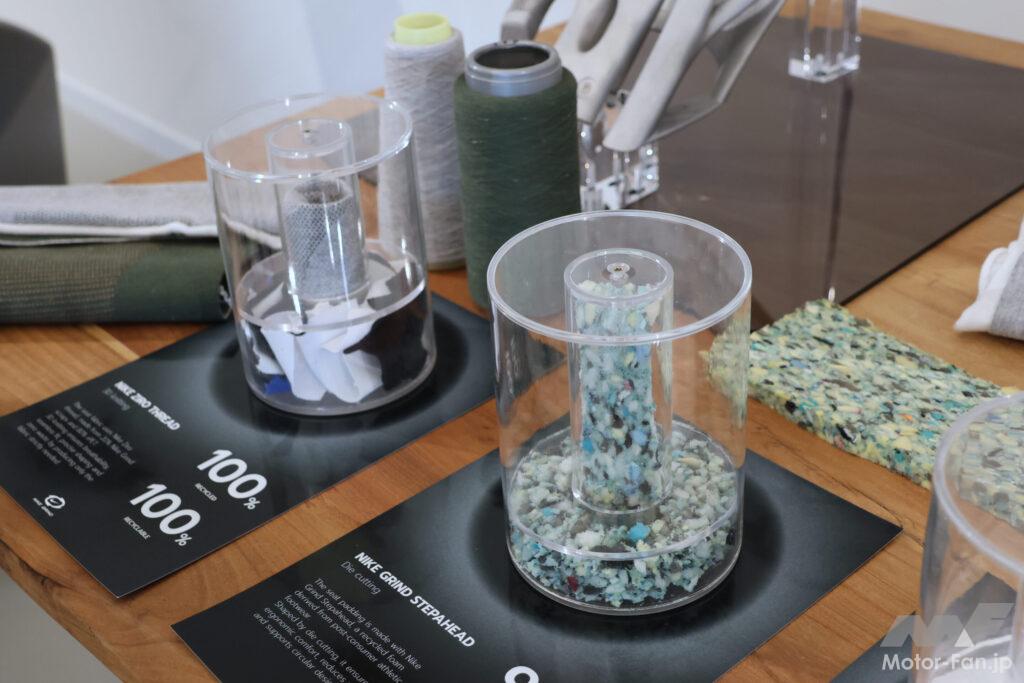
4.Integration of Nike Grind materials as an authorized licensee — a Nike program that collects excess materials from the manufacturing process and materials from used products

Main technologies employed:
・Structural material made from 100% recycled metal powder: Achieves both lightweighting and component simplification
・3D-printed thermoplastic polyurethane (TPU) lattice pad: Adopted as a replacement for conventional urethane foam and adhesives; improves both breathability and disassembly
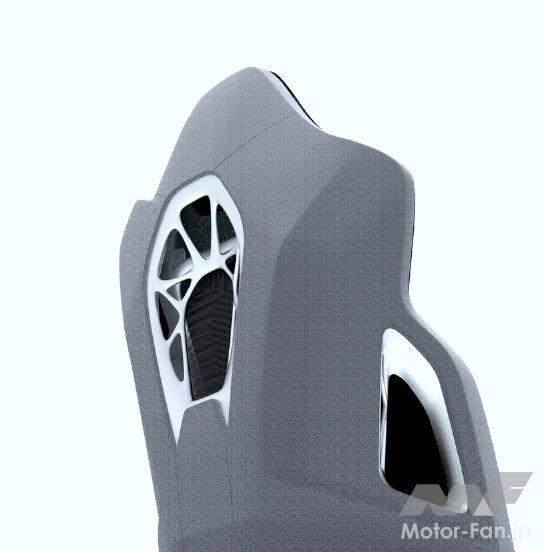
・3D knit textile: Uses blended yarn (20% offcuts via Nike Grind, 80% recycled polyester); produces a seamless trim that minimizes waste
The two project leaders who guided me through a demonstration unit were:
・Matilde Piccioni — Sustainability & Clean Tech Strategic Group
・Alfredo Castiglione Morelli — Overall Interiors & Exteriors Engineering

Q: Why was the seat chosen as your subject of research?
Matilde Piccioni (MP): The seat is one of the most complex components in a vehicle. It is made up of countless materials bonded and sewn together, and that complexity affects not only manufacturing but also end-of-life processing. Separating the materials is extremely difficult — the entire seat must simply be removed and discarded. Its sustainability rating is zero. So we decided to run experiments using new materials and 3D printing technology, with the aim of optimizing processes to reduce and reuse waste, making effective use of materials, lowering environmental impact, and making all components recyclable. At the same time, one of our research goals was to explore how flexibly the seat could be customized — at both the design and manufacturing stages — based on the end customer’s requirements.
Q: What led to the collaboration with Nike Grind?
MP: In our 2024 concept car Quintessenza, we placed great emphasis on the relationship between humans and nature. In that context, we began exploring natural and innovative materials, which is how we came to connect with Nike Grind. In that vehicle, we used materials from Nike footwear for the floor covering. That became the starting point for Italdesign to be an authorized licensee of products containing Nike Grind materials. The ReSedo project explored new possibilities by testing materials sourced from industries that don’t use adhesives — the fashion industry in particular. It was a wonderful experience. We were able to gain a panoramic view of where their used materials come from, how they are recycled, and how they can be made recyclable again. We also discussed reducing waste in the manufacturing process and optimizing disassembly at the end of a product’s lifecycle.


Materials and Development Process
Q: Tell us about the trim cover — the outer surface.
MP: ” We use a recycled fabric composed of 80% recycled polyester and 20% Nike Grind textile scraps. The manufacturing process employs 3D knitting technology (editor’s note: whole-garment technology — a technique that knits seamlessly, much like a 3D printer). No chemical treatments are applied.
Q: Can seat heaters be integrated?
MP: Conductive copper wire is also knitted into the fabric to provide a heating function. This allows for significantly greater weight reduction compared to conventional seat heaters.
Q: What lies beneath?
MP: That is “StepAhead by Future Form” filling foam, which consists of laminated polyurethane foam containing at least 20% Nike Grind material and functions simply as padding and has no ergonomic role.
Q: What actually supports the occupant?
MP: TPU (thermoplastic polyurethane) pad serves as the replacement for the multi-layer structure found in conventional seats. Its lattice geometry can be customized to achieve the desired level of comfort. From a materials standpoint, however, this is currently the least sustainable element. That is because there are technical limitations to the materials that can currently be used with 3D printers — it is an area that requires further research.
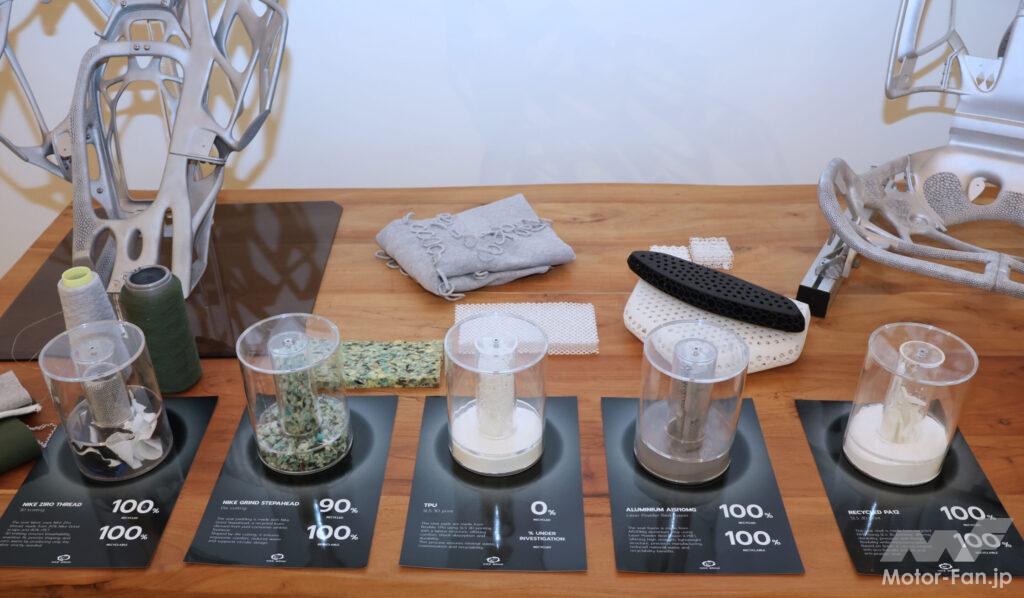


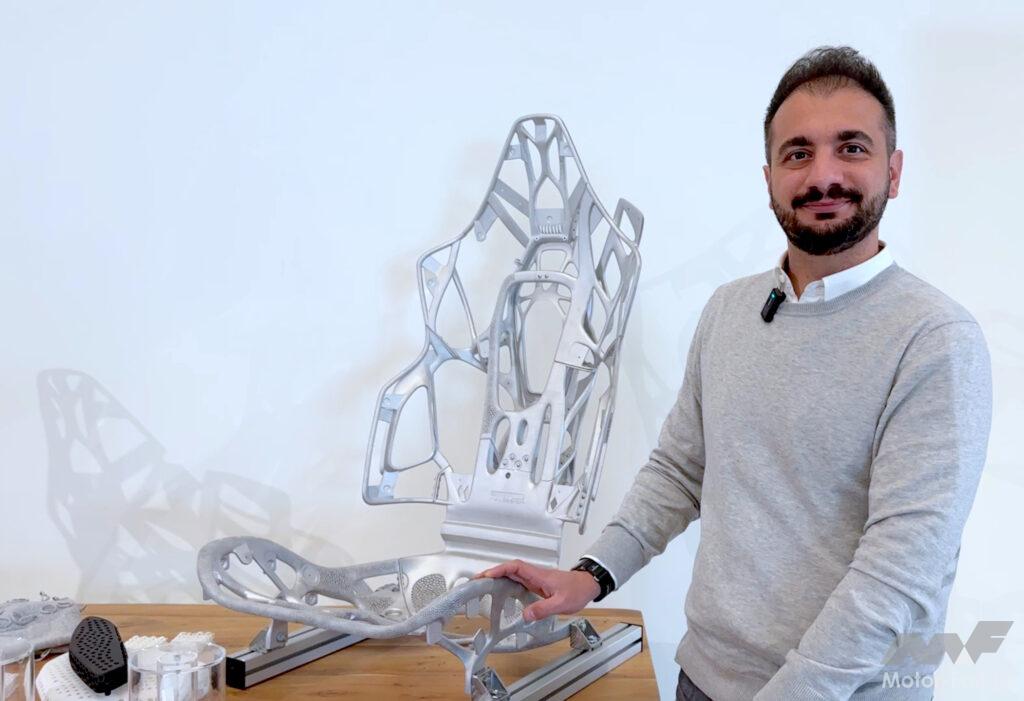
Alfredo Castiglione Morelli (AM): The load-bearing structural parts are produced on a metal 3D printer using recycled metal powder — specifically an aluminum alloy known as AISI10MG. Development began from spatial design: we envisioned a total volume considerably larger than that of an actual seat. At the detail level, we pursued topological optimization.
Q: What does that mean specifically?
AM: We identified the points where loads are applied and reinforced them with greater thickness. The seatbelt mounting point is a good example — it must be designed thick enough to support the loads restraining an occupant in the event of an accident. In contrast, areas that do not require robust structure were stripped of excess, which led to the design you see here.
First, we conducted a simulation and verification phase for the materials to be used, followed by correlation validation, and produced several samples. We then carried out tensile and compressive testing on the samples to verify the material properties of this shape after heat treatment.
Q: What is the overall weight?
MP: The current weight is just under 25 kg, but further weight reduction is anticipated through structural optimization — for example, by eliminating the integrated seatbelt.
Q: Will moving parts be incorporated in the future?
MP: We have begun investigating a full tilt function — one where the entire seat moves, as in a carbon monocoque seat — rather than just adjusting the backrest angle. In other words, height adjustment would not be performed mechanically; instead the entire seat would move. Other adjustment functions are also under consideration, though they carry the risk of adding weight, so we need to find the right compromise.
MP: Each formed layer is attached to the structure without any adhesives, chemical treatments, or stitching, making the seat as a whole a sustainable component.
Q: What was the most difficult stage in development?
MP: As with any project, one of the greatest challenges was the integration of the creative dimension — design — with the technical dimension — engineering. Over several months of development on the demonstrator, we prioritized creating a beautiful object from a design perspective, while keeping in mind the achievement of goals such as sustainability, customizability, and flexibility.


Customizability and the Path to Production
MP: This seat is designed primarily for use in super sports cars and luxury models. It can also be applied across various sectors — aerospace, industrial design, and other areas of mobility.
Q: Please explain the customization potential.
MP: In theory, each user’s body could be scanned to assess their comfort needs and seating posture, and pads could be designed accordingly in specific sizes, positions, and shapes.
AM: Since the structural parts are also produced via 3D printing with metal powder, weight optimization and customization based on seat design are possible. This demonstrator features an integrated seatbelt, but even if it were not included initially, redesigning and reprinting it would minimize cost and development time. Additionally, thanks to 3D printing, large-scale manufacturing facilities are not required — high capital investment is avoided and a wide range of applications is supported.
Because no conventional tooling is required in production, changes to design, shape, or structure — as well as the addition or removal of parts — are straightforward. For structural elements, it is simply a matter of modifying the CAD data points and reprinting.

Q: Has research into crash safety been conducted?
AM: In this prototype study, we did not run actual crash load cases. Verification was carried out in the virtual environment only.
Q: How long do you expect it to take to bring this to market?
MP: We have formulated a hypothesis for the journey from proof-of-concept to the start of limited production. We estimate a development period of approximately 9 to 12 months. This encompasses all engineering work, including virtual validation, physical validation, on-road testing, and testing in the seat itself rather than in-vehicle.
Q: Have you begun looking into homologation?
MP: We have started compiling a list of activities and items to be confirmed in order to bring the seat into mass production and obtain type approval, though actual work has not yet begun. Virtual structural simulations already target both the European and US markets, and we are looking to expand globally. Specifically, we are considering not only new vehicle fitment but also the possibility of supply as an aftermarket product — the latter of which would not require specific type approval.
Q: So the aftermarket could be a viable market as well?
MP: It could be one of the options.
Q: Some drivers use only public roads, while others enjoy track days.
MP: At this initial stage, we are focusing on road cars. Race vehicles are subject to different conditions regarding type approval and certification, but it is certainly worth exploring.
AM: To bring this seat to a mass-production level, separate physical validation will be required. Whether it will ultimately reach mass production is something we cannot say at this stage. That said, the engineering work — seat design and customization for end customers — will always be carried out by Italdesign.
Q: How many suppliers would be needed for mass production?
AM: One supplier for the structure, plus suppliers for the pad and for the backing fabric.


Q: Will it be significantly more expensive than a conventional seat?
MP: The price range for existing seats spans widely — from standard seats in the hundreds of euros, all the way up to carbon fiber monocoque and premium seats in the thousands. Given the technologies we employ, we are aiming for the higher end of the market: a premium segment priced from €15,000 to over €20,000.
Those are the thoughts of the developers behind the ReSedo project. Through them, one can sense that the founding spirit of seamlessly uniting design and engineering — along with the minimalism this company has cultivated over many years — is being faithfully passed on by a new generation.
Until next time, everyone — Arrivederci!
カーデザインの関連記事


全固体電池搭載のフル電動スポーツ「プジョー RCZ ビジョン」のデザインコンセプトを公開【動画】

![by Car Styling [カースタイリング]](https://motor-fan.jp/wp-content/uploads/2025/04/carstyling-jp_logo.png)
メルセデスAMGが初めて一から自社開発したフルサイズ電動SUV「GT SUV」がデビュー


2007年のトヨタ「Hybrid X」は未来のプリウスだった? 15年後の5代目プリウスと比較してわかった意外な共通点

空を飛ぶテスラの新型ロードスター。ライトや空力パーツをボディに溶け込ませたミニマルなエクステリアにも注目

リープモーターがパリで新型コンパクトEV「B03」を欧州初披露。2トーンのボディで軽快さを表現
