Unique Scandinavian Motorcycle Design / Husqvarna Vitpilen 801
![by Car Styling [カースタイリング]](https://motor-fan.jp/wp-content/uploads/2025/04/carstyling-jp_logo.png)



TEXT: Kazuhiko Saito
PHOTO: Tatsuo Nagano
Husqvarna Motorcycles was established in 1903 as the motorcycle division of the Swedish company Husqvarna. After going through several mergers and acquisitions—including a period under BMW—the brand is now part of the same corporate group as KTM. Husqvarna has traditionally been strongly associated with off-road motorcycles, but its on-road models, which utilize KTM platforms, have been attracting attention for their distinctive and unique design.
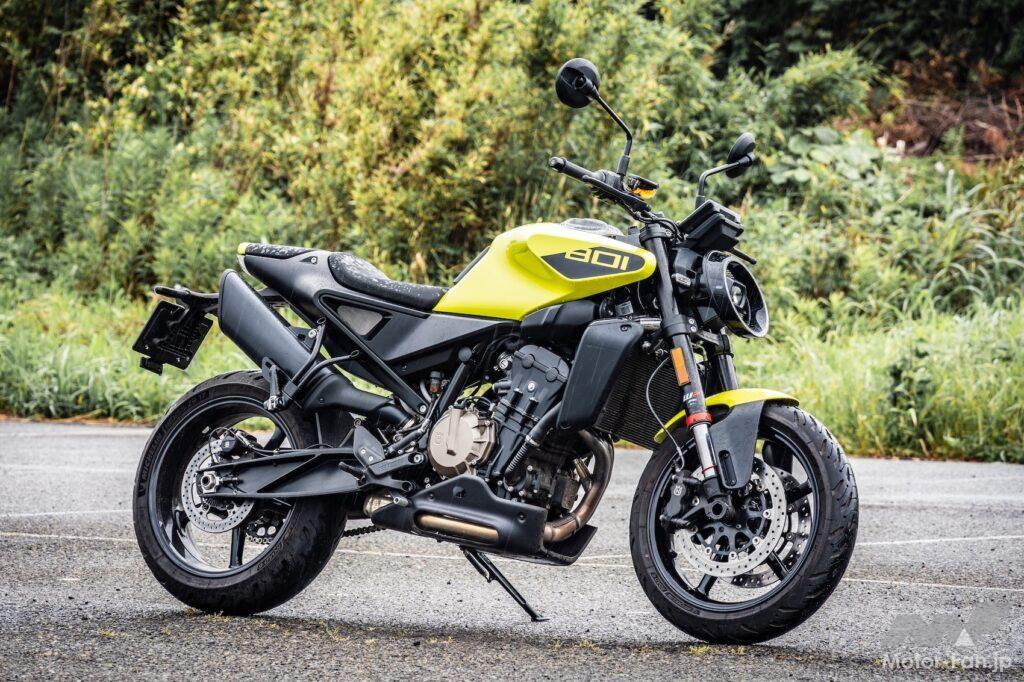
Husqvarna’s on-road motorcycle lineup can be broadly divided into three categories: the Norden adventure series (off-road-oriented touring bikes), the Supermoto series (road-going motorcycles derived from off-road bikes), and the Nakedsports bike series. Without going into detail on each category here, the Naked range consists of two series: Vitpilen and Svartpilen. The former is a road-sport model, while the latter is a scrambler-style model with a slightly more off-road character.
The 801 is available in both Vitpilen and Svartpilen versions. Although the two share the same basic platform, they differ in tires and other specifications and equipment. Both made their debut this year as new models. The road-sport Vitpilen lineup also includes the smaller Vitpilen 401 as a sibling model to the Vitpilen 801.
The model featured here is the Vitpilen 801, a sports bike. Despite the “801” designation, its actual engine displacement is 799 cc, and it is powered by an engine from the same family as KTM’s 790 series, including the 790 Duke. In addition to the engine, it shares many components with KTM models, including the main frame and suspension. Yet its highly distinctive design makes this shared engineering almost unnoticeable at first glance.
Although the overall composition is simple, the vivid, almost lemon-yellow body color creates a striking contrast with darker elements in black and gunmetal, giving the bike an even stronger visual impact.
A closer look at the design reveals a number of distinctive treatments and forms rarely seen on models from other manufacturers. In addition to this vivid yellow, a silver metallic color is also available.
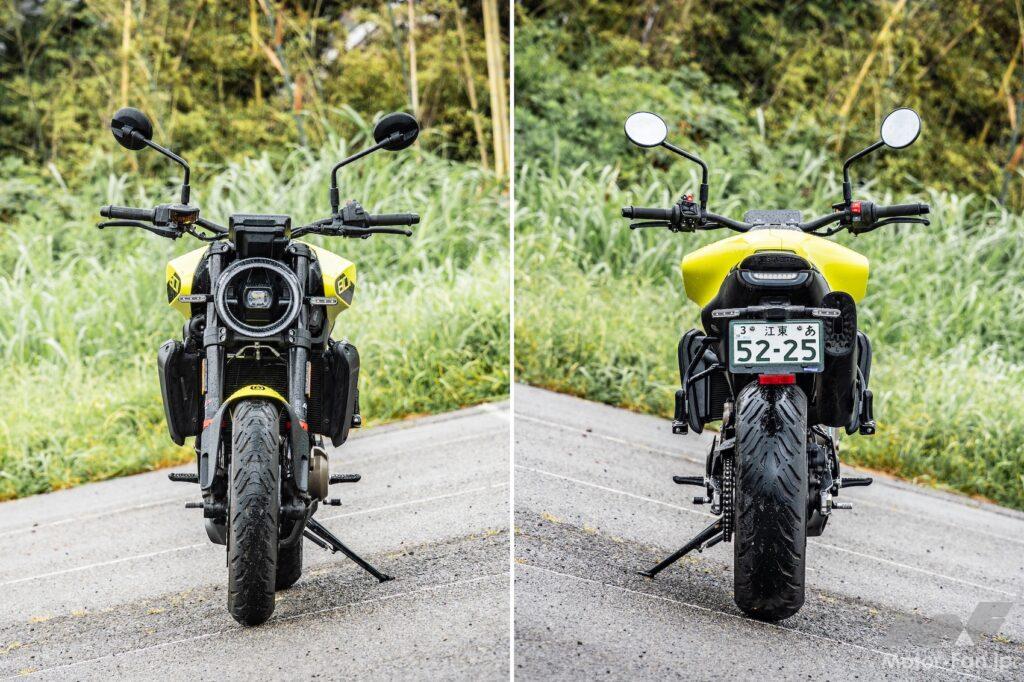
Uniquely Designed Components
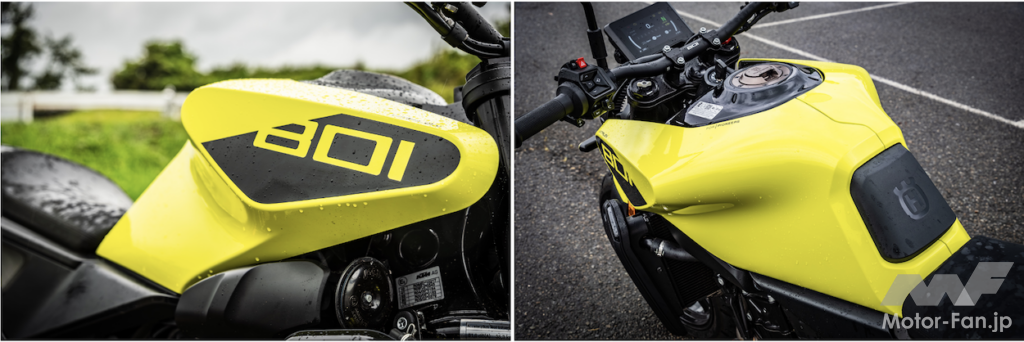
The fuel tank—or more precisely, the tank cover—is arguably the most distinctive design element of the Vitpilen 801. The tank as a whole is characterized by gently curved surfaces. Even around the knee-grip area, rather than using deeply sculpted recesses, the surfaces remain clean, with gradually changing curvature that gives the tank a suitably slim and compact width.
Toward the front, the tank flares outward like the head of a hammerhead shark, with the tips appearing to be sliced off by vertical surfaces. This treatment is unlike that of almost any conventional motorcycle fuel tank and strongly expresses Husqvarna’s design originality. The combination of flowing surfaces, sharply defined lines, and vertical planes is particularly striking. These cut-off surfaces also provide space for the 801 graphics, further emphasizing the tank’s distinctive cross-sectional form.
Viewed from the rear, another interesting detail becomes apparent: the left and right tank covers do not meet along a straight centerline, but instead join along a zigzag seam. This is an effective technique for creating a smooth visual transition between the surfaces of the two tank covers, and appears to reflect careful attention to preserving the intended tank form. The addition of the tank pad also helps conceal the fastening points and seam lines, keeping the overall appearance clean.
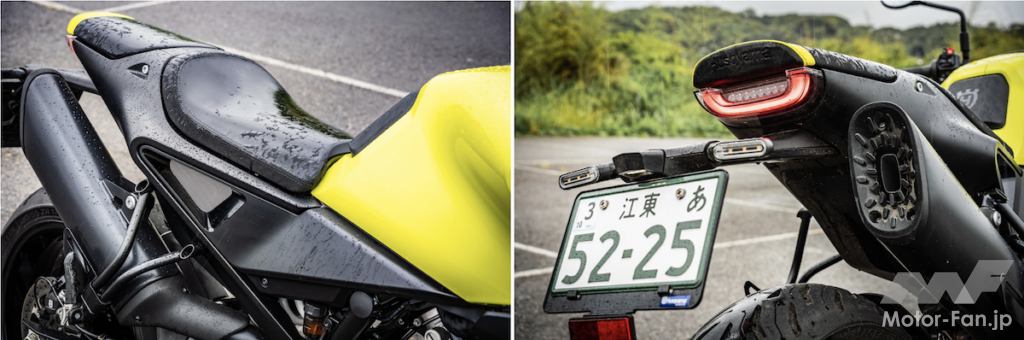
The form extending from the side covers to the rear cowl is also composed of gently curved surfaces, creating the impression of a single continuous mass. Even the seat appears to fit into this volume as though a section of the form had simply been cut away. The treatment could be compared to the concept of a flush surface often used in automotive design.
The way the rear cowl projects forward appears to echo the form of the fuel tank. Where it meets the side cover, however, the surface incorporates an air-intake opening. This area has a somewhat inorganic, flat, triangular form, creating a clear contrast with the softer, more sculptural surfaces of the fuel tank and rear cowl.
The rear end of the pillion seat is also cut off with an almost vertical surface, revealing an elongated oval cross-section. The upper half is formed by the seat itself, embossed with the Husqvarna logo, while the lower half incorporates the LED brake light.Rather than treating the brake light as a separate functional component, it has been integrated into the seat and made part of the overall form. This seamless integration of function into the bodywork is another particularly interesting aspect of the Vitpilen 801’s design.
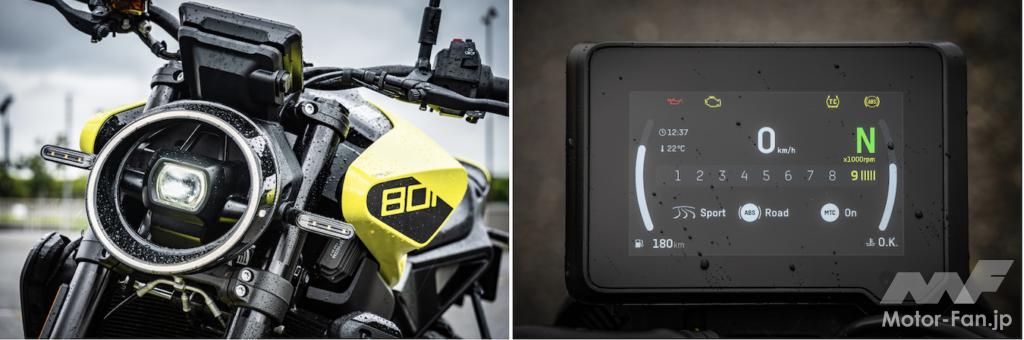
The headlight consists of a ring-shaped LED, referred to as the “light ring,” with a small rectangular projector lamp positioned in the center as if it were floating within the ring. This distinctive arrangement gives the Vitpilen 801 a highly individual front view. The light ring itself has a cylindrical form that allows the airflow to pass through it and is treated visually as an element independent of the headlamp. Viewed from the side, the light ring is angled so that it runs parallel to the front fork, revealing a clear design intention to establish a visual relationship between different components.
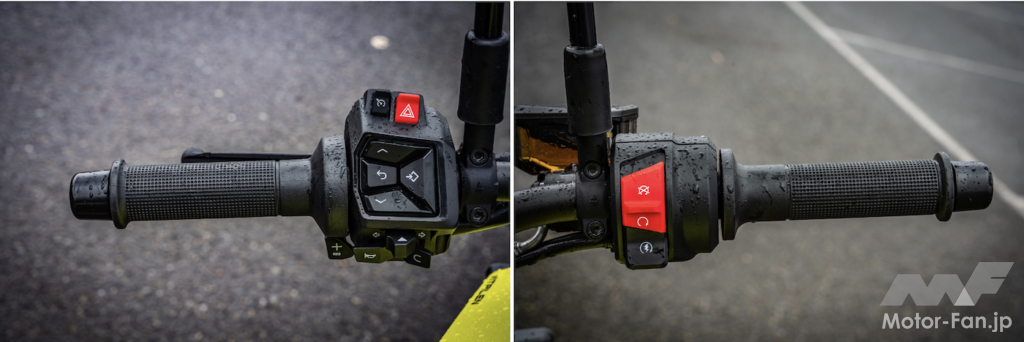
The turn signals use slim, compact LEDs, as is common on contemporary motorcycles. Their simple horizontal form is deliberately understated, allowing them to play a supporting role without distracting from the bike’s more distinctive design elements.The instrument display is a rectangular digital LCD panel. Its layout is simple and straightforward, with the speed and gear position clearly visible. The tachometer uses a horizontal moving-bar display, while other functions and display settings can be controlled using the handlebar switches. Smartphone connectivity and riding-mode selection can also be operated through the handlebar controls.
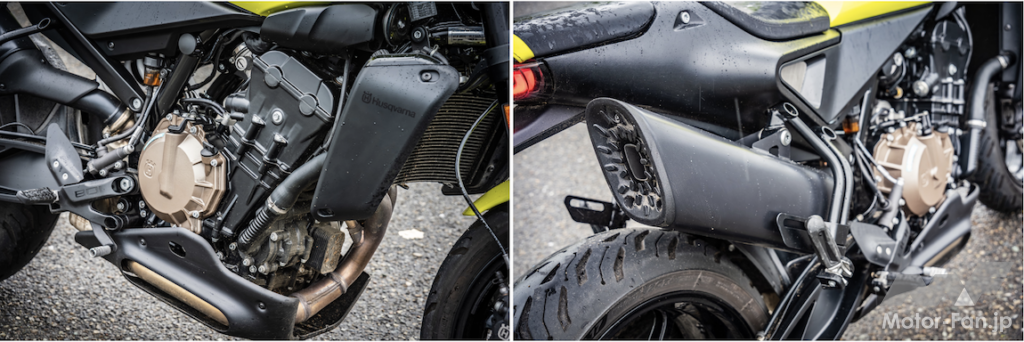
The engine is derived from KTM’s 790 series, but the clutch cover features the Husqvarna logo and is finished in a distinctive brownish color to differentiate it from its KTM counterpart. The ribbed detailing on the clutch cover is particularly eye-catching, visually expressing a sense of mechanical precision and lightweight construction.
As this is a two-cylinder engine, two exhaust pipes emerge from the front of the cylinders and run downward along the frame. The pipes follow the same curves in parallel, almost twisting around each other, before merging beneath the motorcycle, where the catalytic converter is located.
A cover is fitted beneath the engine for heat management as well as visual purposes. However, elongated horizontal openings in the cover expose portions of the exhaust pipes, helping to reduce the visual weight of this area. Rather than being finished in matte black, the pipes retain a metallic sheen, giving the motorcycle a more rugged character while also allowing the owner to enjoy the heat-induced coloration that develops on the metal over time.The muffler itself is an upswept design that rises toward the rear along the line of the rear cowl. Its elongated oval cross-section echoes other elements of the motorcycle, and the muffler terminates in an almost vertically cut surface that visually corresponds with the rear edge of the seat. Radial detailing around the rectangular exhaust outlet adds another carefully considered design accent, demonstrating the attention paid even to the smallest details.
The swingarm appears to utilize the same die-cast aluminum construction that KTM is known for, but what stands out is the way its truss-like rib structure is deliberately exposed and treated as a visual design element. A similar type of swingarm is also used on other Vitpilen and Svartpilen models.
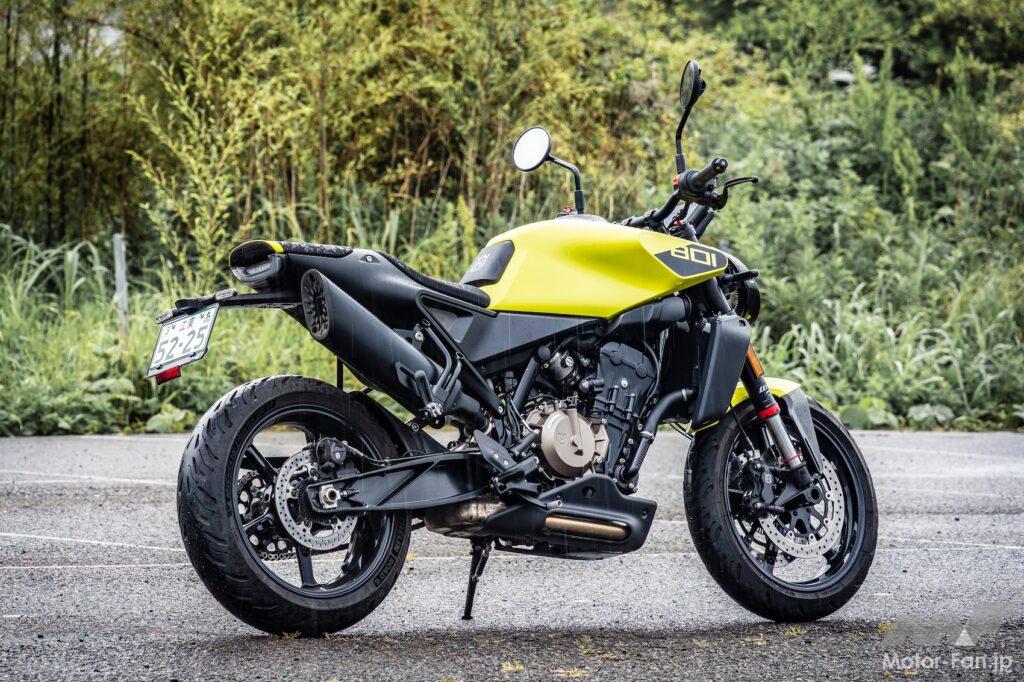
Viewed from the side, it becomes clear how distinctive lines run across individual body components, visually connecting them with one another. In motorcycle design, individual components are generally shaped independently according to their respective functions, a tendency that is particularly evident in more traditional motorcycle designs. The Vitpilen 801, however, takes a very different approach. Its continuity of lines and surfaces creates a strong sense of three-dimensional unity, resulting in a design that can truly be described as unique.
One of the Vitpilen 801’s defining characteristics is the way its clean, sculpted bodywork is integrated with the contrasting mechanical character of the frame, engine, and other functional components. Despite their different visual qualities, these elements come together to form a coherent whole, giving the Vitpilen 801 its distinctive identity.
Perhaps this approach reflects something of the clean and functional character of Scandinavian design, rooted in Sweden and the other Nordic countries.
Main Specifications
Overall Length × Width × Height (mm): N/A
Wheelbase (mm): 1,475
Seat Height (mm): 838
Vehicle Weight (kg): 180
Engine Type: Liquid-cooled, 4-stroke, DOHC, 4-valve, parallel twin
Displacement (cc): 799
Maximum Power: 77 kW [105 PS] / 9,500 rpm
Maximum Torque: 87 N·m / 8,000 rpm
Transmission: 6-speed
Tire Size: Front 120/70 ZR17 / Rear 180/55 ZR17
Fuel Tank Capacity (L): 13.7
カーデザインの関連記事

Cd値は0.24を達成。空力を突き詰めながら、室内空間は犠牲にしない。アウディA2 e-tronは効率を軸にしたコンパクトBEV

世界初、曲面で光るデジタルOLEDを採用。TT RSから10年、アウディQ9のテールライトが到達した新段階


スバルはなぜ「この顔」を捨てたのか? 2003年のB11Sが描いた未来と、ヘキサゴングリル誕生の真相

全長3mで4人乗りを実現。フィアット・ムルティプリーナは600ムルティプラのコンセプトを現代に継承

部品点数を抑えた合理的なデザイン。プロポーションから一新されたAセグメントBEVの2代目「ダチア・スプリング」
